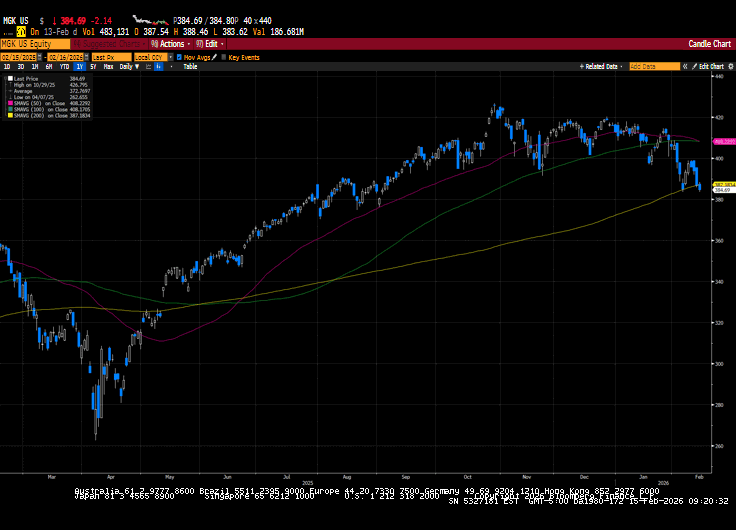
US financial markets regressed in choppy trade. The narrative around the disruptive nature of AI continued to impact markets. Rotation away from growth and mega-cap issues continued while proceeds flowed to defensive sectors and small caps. Interest rate-sensitive sectors, such as the utilities and real estate, benefited from lower rates across the curve. Q4 earnings remained robust, but as we have seen in the last few weeks, better-than-expected results have often been met with selling the news.

The S&P 500 lost 1.4%, the Dow fell 1.2%, the NASDAQ gave back 2.1%, and the Russell 2000 shed 0.9%. US Treasury yields fell across the curve for the second week in a row. The 2-year yield fell by nine basis points to 3.41%, while the 10-year yield fell by fifteen basis points to 4.06%. West Texas Intermediate Crude prices fell by 1.1% to $62.85 per barrel. Gold prices increased by $64.10 or 1.3% to $5044.10 per ounce. Silver prices fell by 1.1% to $77.96 per ounce, while Copper prices fell by 1.8% to $5.80 per Lb. Bitcoin’s price fell 3% to $69,000. The US Dollar index fell 0.7% to 96.92.

S&P 500 2/13/2026
Economic data showed benign inflation and better-than-expected employment figures. Non-Farm Payrolls increased by 130k versus the consensus estimate of 68k. Private Payrolls increased by 172k versus an estimated 60k. The Unemployment Rate fell to 4.3% from 4.4%. Average Hourly Earnings increased by 0.4% versus the estimate of 0.3%. The Average Workweek increased to 34.3 hours from 34.2 hours in November. Headline CPI increased by 0.2% versus the consensus estimate of 0.3% and was up 2.4% year over year relative to 2.7% in December. Core CPI, which excludes food and energy, came in line with estimates at 0.3% and fell to 2.5% from 2.6% year over year. Retail Sales showed consumers backing away from purchases in December. Headline Retail sales were flat versus expectations for an increase of 0.4%. The Ex-Auto reading was also flat versus the consensus estimate of 0.4%. Initial Claims decreased by 5k to 227k, while Continuing Claims increased by 21k to 1.862k. Finally, the Employment Cost Index came in at 0.7%, slightly below the expected 0.8% increase.

Investment advisory services offered through Foundations Investment Advisors, LLC (“FIA”), an SEC registered investment adviser. FIA’s Darren Leavitt authors this commentary which may include information and statistical data obtained from and/or prepared by third party sources that FIA deems reliable but in no way does FIA guarantee the accuracy or completeness. All such third party information and statistical data contained herein is subject to change without notice. Nothing herein constitutes legal, tax or investment advice or any recommendation that any security, portfolio of securities, or investment strategy is suitable for any specific person. Personal investment advice can only be rendered after the engagement of FIA for services, execution of required documentation, including receipt of required disclosures. All investments involve risk and past performance is no guarantee of future results. For registration information on FIA, please go to https://adviserinfo.sec.gov/ and search by our firm name or by our CRD #175083. Advisory services are only offered to clients or prospective clients where FIA and its representatives are properly licensed or exempted.